

Chicken vs Zombies isn't your typical slot or table game—it's a high-stakes, player-vs-environment battle mode where survival directly dictates your payout. The longer you avoid elimination, the higher your exit multiplier climbs. But unlike passive slot spins, this mode demands active decisions, timing, and disciplined risk management.
This guide breaks down the real mechanics behind the game, explains how multipliers evolve, and—most importantly—shows how to approach it without blowing your bankroll in seconds. We'll treat it like a volatile investment: high upside, high risk, and no guarantees.
At its core, Chicken vs Zombies is a "crash-style" survival game developed by InOut Games. You place a stake, then enter a round where waves of zombies advance. Your chicken must dodge, survive, and outlast the horde. Each second (or round) you survive increases your potential cashout multiplier—starting at 1.0x and climbing rapidly.

Crucially, you control the exit:
Unlike slots with fixed RTPs, the theoretical return in Chicken vs Zombies is dynamic and depends entirely on your cashout behavior. The game's base RTP is 95.5%—but only if you cash out at statistically optimal points. In practice, most players cash out too early (missing upside) or too late (getting eliminated), resulting in a net loss over time.
| Provider | InOut Games |
|---|---|
| Game Type | Crash / Sequential Multiplier |
| RTP | 95.5% |
| Stake Range | 0.01 to 200 per round |
| Max Single Win | Up to 20,000 (currency depends on platform) |
| Difficulty Presets | Easy (30 zombies), Medium (25), Hard (22), Hardcore (18) |
| Fairness Technology | SHA256 server seed hashing + client seeds (provably fair) |
| Release Year | 2025 |
The multiplier doesn't increase linearly—it accelerates. Early survival (1.0x to 2.0x) is relatively easy, but the difficulty spikes quickly. By the time you reach 5.0x, zombie speed and aggression often double, making survival increasingly unlikely.
Here's a realistic breakdown of risk progression:
| Difficulty | Total Zombies | Risk Level | Multiplier Acceleration | Recommended Strategy |
|---|---|---|---|---|
| EASY | 30 Zombies | Lower Risk | Gradual (1.01x, 1.03x, 1.06x increments) | Auto-cashout at 2.0x–2.5x for consistent small wins |
| MEDIUM | 25 Zombies | Moderate Risk | Moderate (faster progression than Easy) | Target 2.5x–3.5x with strict auto-cashout discipline |
| HARD | 22 Zombies | High Risk | Rapid (each victory compounds faster) | Only for experienced players; cap at 4.0x |
| HARDCORE | 18 Zombies | Maximum Risk | Exponential (high rewards, extreme elimination probability) | Test-only mode; avoid with serious bankrolls |
Remember: every round is independent. Past survival doesn't increase your odds in the next round. The RNG resets completely on each new game.
Chicken vs Zombies is a high-variance game. A single session can end in 3 seconds or 3 minutes. Without a bankroll plan, you'll burn through funds chasing "just one more round."
Follow these rules:
Example: With a $40 session bankroll and $1 per round, you can play 40 rounds. At a 2.0x auto-cashout, you'd need to win just 21 rounds to break even (21 × $2 = $42). Given typical survival rates in the 1.0x–2.0x range, this is achievable—unless you override your auto-cashout.
| Session Budget | Stake per Round | Total Rounds Available | Auto-Cashout Target | Wins Needed to Break Even |
|---|---|---|---|---|
| $20 | $0.50 | 40 rounds | 2.0x | 21 wins (52.5% win rate) |
| $50 | $1.00 | 50 rounds | 2.5x | 21 wins (42% win rate) |
| $100 | $2.00 | 50 rounds | 2.0x | 26 wins (52% win rate) |
| $200 | $5.00 | 40 rounds | 3.0x | 14 wins (35% win rate—risky) |
Most losses in Chicken vs Zombies come from behavioral errors, not bad luck:
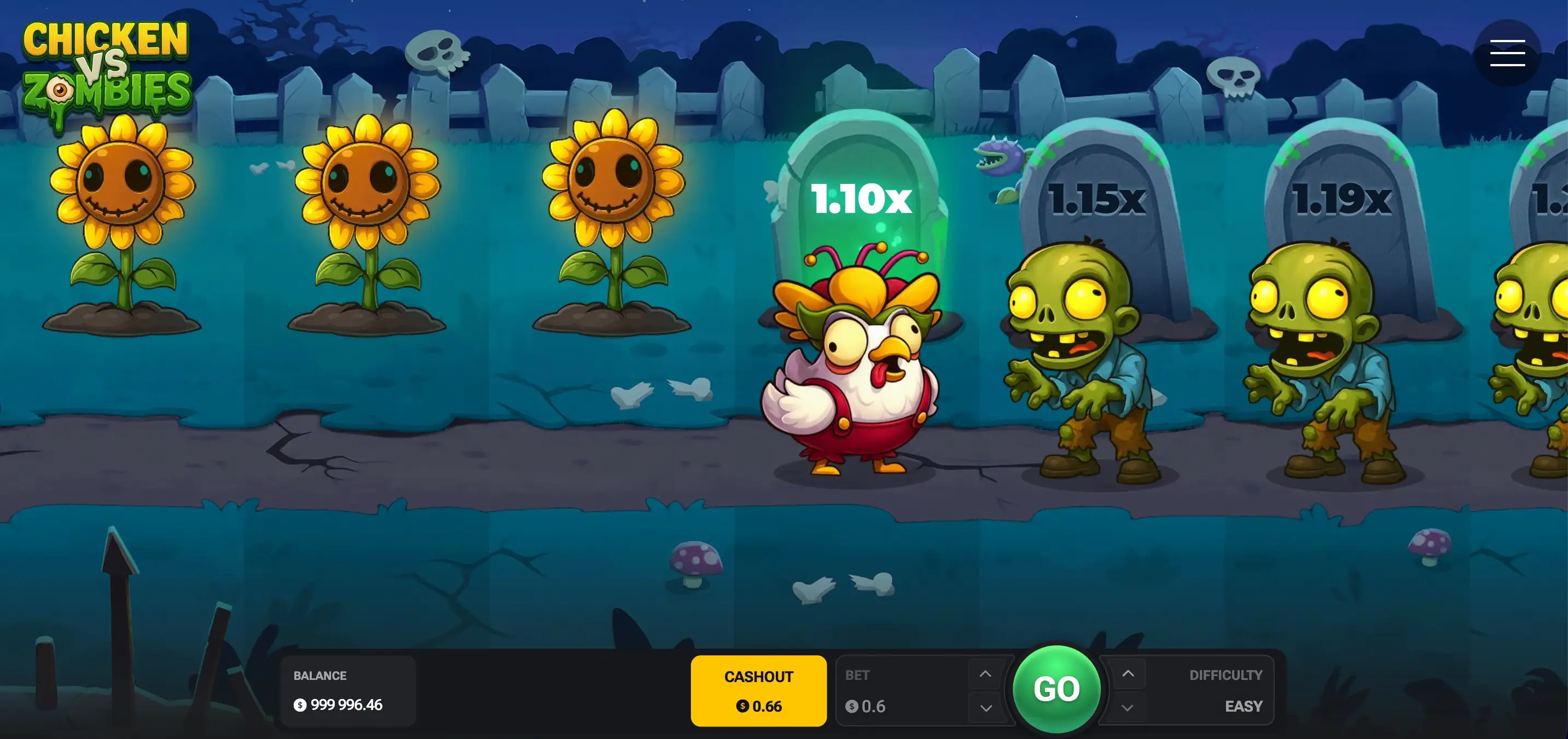
Understanding the interface helps you make faster, more disciplined decisions. Chicken vs Zombies uses a color-coded feedback system to communicate game state:
The control panel spans full width with semi-transparent overlay. Balance displays on the left, bet controls in center with increment/decrement arrows, and the play button dominates center position. This layout prioritizes mobile usability—critical for a game where split-second decisions matter.
No, the game isn't rigged—if it's hosted on a licensed platform. Reputable operators use certified RNGs (Random Number Generators) to determine zombie behavior, spawn timing, and elimination triggers. Each round is provably fair in regulated markets, with results verifiable via hash chains or third-party audits.
InOut Games implements SHA256 server seed hashing combined with client seeds. Round results generate before the game starts, ensuring neither the operator nor the player can manipulate outcomes mid-round. You can verify each result's fairness by checking the hash against the published server seed after each round completes.
However, fairness doesn't mean favorable odds. The house edge is built into the multiplier curve. Over millions of rounds, the operator will retain ~4.5% of all stakes—exactly as the 95.5% RTP predicts. Your job isn't to "beat" the system, but to manage your exposure within it.
SHA256 server seed hashing ensures each round's outcome is predetermined and verifiable. Client seeds add an extra layer of transparency, preventing server-side manipulation.
Licensed platforms hosting Chicken vs Zombies undergo regular third-party audits. Look for GLI, iTech Labs, or eCOGRA seals on the operator's site.
Most implementations display your last 10–20 rounds with exact multipliers and outcomes, helping you track performance and identify behavioral patterns.
Set deposit limits, loss limits, and session time caps before playing. Most jurisdictions require operators to offer self-exclusion and reality check features.
Chicken vs Zombies is optimized for cross-platform performance, with mobile-first design ensuring smooth gameplay on smartphones and tablets.
| Platform | Type / Availability | How to Access | Notes |
|---|---|---|---|
| Android | Responsive Web / PWA | Browser access (Chrome, Firefox); add to home screen via PWA | No dedicated APK required; instant-play via mobile browser |
| iOS | Responsive Web / PWA | Safari or Chrome; add to home screen for app-like experience | Full feature parity with desktop; optimized touch controls |
| Desktop | Browser-based (HTML5) | Direct access via casino website; no download needed | Larger screen aids in tracking multipliers, but mobile controls are faster |
The semi-transparent control panel and vertical-stacking layout ensure the game remains playable even on small screens. Tap-based cashout is optimized for thumb accessibility, reducing the risk of missed exits during critical moments.
Remember: this is entertainment, not income. The only guaranteed win is knowing when to stop.
The theoretical maximum varies by difficulty mode, but most versions cap between 100x and 1000x. However, reaching even 10x is statistically rare due to exponentially increasing zombie aggression. In Hardcore mode (18 zombies), survival beyond 8x is extremely unlikely. Don't bank on hitting the cap—focus on consistent 2x–3x exits instead.
Often, no. Many casinos exclude crash-style games like Chicken vs Zombies from bonus wagering due to their high volatility and player-controlled cashout mechanics. Always check the bonus terms before depositing. Some platforms may allow it, but expect significantly higher wagering requirements (60x–80x) compared to slots.
No. The game is governed by RNG and designed with a house edge (4.5% at 95.5% RTP). No strategy can eliminate risk or guarantee profit. The only "winning" strategy is disciplined bankroll management (never stake more than 2–5% of your session budget per round) and knowing when to walk away. Auto-cashout at 2.0x–2.5x maximizes your long-term survival probability.
Difficulty controls the total number of zombies you face, which determines how quickly multipliers accelerate. Easy mode (30 zombies) offers the slowest, most predictable progression—ideal for beginners. Hardcore mode (18 zombies) compounds multipliers faster but dramatically increases elimination probability after 5x. Your base RTP remains 95.5% across all modes, but variance increases sharply on Hard and Hardcore.
Yes, if playing on a licensed platform that supports provably fair technology. After each round, you can check the SHA256 hash of the server seed against the published result. The client seed (which you can set or randomize before each round) ensures neither party can manipulate outcomes. Look for a "Fairness" or "Provably Fair" button in the game interface.
Your auto-cashout setting remains active even if you disconnect. If the multiplier hits your pre-set target before elimination, the system will automatically cash you out and credit your balance. If you set no auto-cashout and disconnect, most platforms will treat it as a forfeit—you'll lose your stake. Always enable auto-cashout before starting any round.
Most licensed casinos offer a free demo version of Chicken vs Zombies. Demo mode uses the same RNG and mechanics as real-money play, making it ideal for testing auto-cashout strategies and understanding zombie behavior patterns. However, demo results do not predict real-money outcomes—each session is independent. Use demo to practice discipline, not to "test your luck."
Stake limits vary by platform, but typical ranges are 0.01 to 200 per round (in the casino's base currency). Low minimums make the game accessible for testing strategies, while high maximums attract experienced players. Always start with the minimum stake when learning, and never exceed 5% of your session bankroll on any single round.